Phone keybar modifiers · #4036
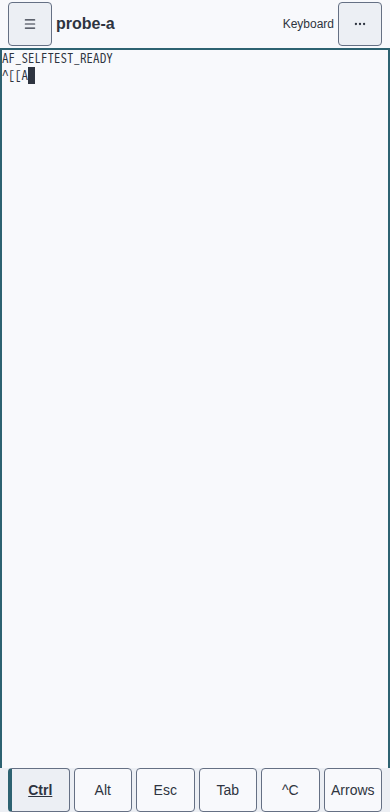
Container-captured phone design stills (390×812):
| Before | After |
|---|---|
 |
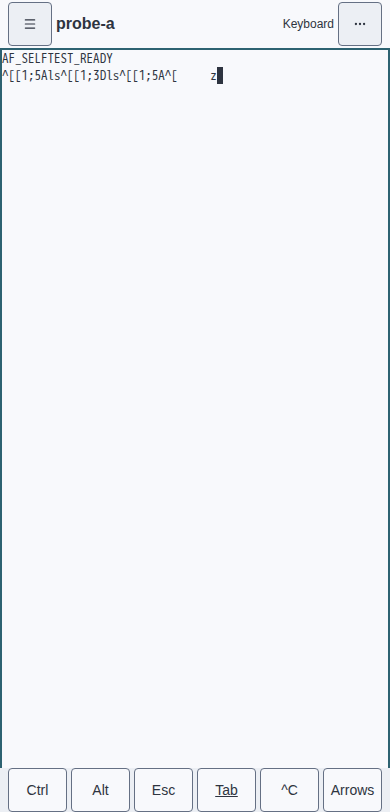 |
The before still is master with the new browser regression: Ctrl → Arrows → Up
→ Back sends plain ESC[A and leaves Ctrl armed. The after still is the fixed
client after the focused modifier flow. The container uses its scripted test
agent; the displayed byte echo is not a real-agent interaction.
Reproduce the browser assertions and screenshots with:
The browser observes actual outgoing binary Op.Input frames via the existing
phoneInputStream seam. Ctrl → Up → soft-keyboard ls must send exactly
ESC[1;5Als; Alt → Left → ls must send exactly ESC[1;3Dls.
Both one-shots clear their state and armed accessibility description.
The focused flow also verifies locked Ctrl + Up, one-shot Alt + Tab + z,
and one-shot Alt + hardware Escape followed by an unmodified a.
The focused phone spec runs these modifier assertions. The demo retains its
visual coverage of plain arrows, interrupt, composition, physical keypresses,
focus, and viewport resizing without leaving line-breaking byte assertions in
the terminal immediately before its screenshots.
Unit red records the issue's two original tests failing against
master before implementation. The second reproduction now invokes the explicit
bar-key operation (key("←")) and expects the modified bytes; its original
input(ESC[D) call represents xterm emissions, which intentionally must not
consume modifiers. The existing terminal-reply preservation test remains intact.
Unit green records all 10 focused tests passing.
Browser red and browser green record the
same browser regression before and after the fix.
No Go TUI design golden changed.
Refocus regression from the full perf lane
CI run 34174632552's trace shows the first (360px) phone pass completing, then
Control+] at 63594ms and textarea refocus at 63623ms. On the second (390px)
pass, Ctrl → Up clears Ctrl, but keyboardInsertText("ls") at 71080ms emits
nothing. The [7m/[27m in the failure message are Playwright's diff highlighting,
not bytes in the captured input. phoneInputStream only records outgoing
Op.Input frames, never PTY output.
Xterm 5 sets _keyDownSeen before invoking the custom shortcut handler. The
shortcut blurs the textarea, so xterm misses keyup and retains that flag. Its
native _inputEvent then discards composed insertText events. The keybar's
existing workaround intercepted only armed input; once the bar consumed the
modifier, the following plain letters fell through to that stale xterm state.
The fix applies the existing soft-input interception to plain text as well.
Physical-key and composition guards remain. The focused regression now repeats
all modifier gestures after Control+] and refocus, then verifies physical
letters are sent once. The shared helper also checks locked Ctrl + Up + soft
x yields ESC[1;5A + 0x18 and remains locked. The focused phone probe runs
these exact input assertions before and after refocus without synthesizing keyup
or resetting xterm; the demo separately exercises the visual phone flow.
Validation after the refocus fix:
- Full
make perf-container: red, then green. All five visual tests passed without golden updates; the three-run web/TUI measurements passed every budget. - Focused container phone spec: refocus red, then refocus green, including the repeat after blur/refocus.
npm test: 744/744; typecheck and rebuiltweb/distpassed.- gofmt, Go build/vet, fast lint, and file-length lint passed.
Full-suite isolation and xterm user-input effects
The next full-suite run exposed a second interaction: the standalone phone spec
had been writing to shared probe-a. Its fake agent is cat; later Enter
submits the pending cursor sequences, which cat echoes as terminal commands.
Those commands overwrite AF_SELFTEST_READY with the phone test's ls/xy
letters. The #2337 scrollback assertion then fails, leaving its own history
behind for the shell/split/scroll/service-worker tests that follow. The local
full suite reproduced this cascade from head 61948022.
The phone spec now creates and kills its own session in try/finally. This
retains the real daemon/PTY assertions without mutating shared fixture output.
The separate demo helper continues to use the demo's scripted terminal.
Codex thread 3952881077 also identified the direct PTY sink's missing xterm
side effects. Bar keys now resolve and consume sticky modifiers, then invoke
the same term.input(data, true) callback as soft input. The existing transform
preserves those complete escape/control byte strings, so locked modifiers are
not applied twice. There is no direct keybar-to-PTY callback anymore.
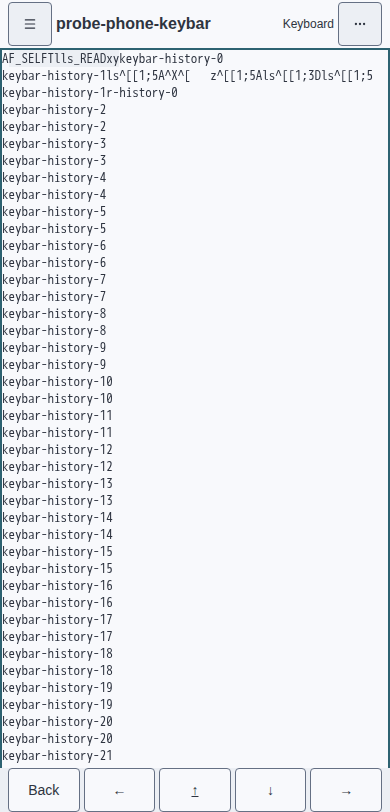
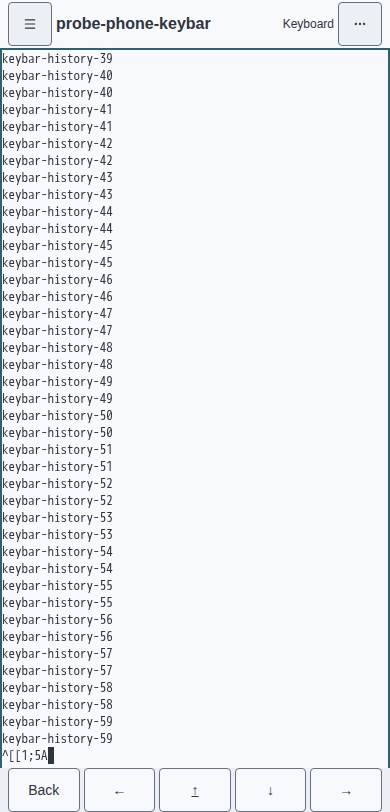
The new browser probe builds scrollback, selects text, then taps Ctrl+Up. It
checks exactly ESC[1;5A, cleared selection, and return to the newest line.
Before the sink fix, the right bytes were sent but two
selection rectangles remained. The screenshots show the same probe before and
after the sink fix:
| Before | After |
|---|---|
 |
 |
At that stage, the full container suite went from
13 failures / 182 passes on 61948022 to 195 passes,
including every reported failing case and the xterm selection/scrollback
regression. The current final-revision transcript supersedes that historical
count below. The local red also caught the related #2347 mobile-geometry case,
which passes in green.
Full perf/visual validation passes all five visual tests
and all web/TUI budgets. Unit tests pass 745/745; typecheck, bundle build,
strict MkDocs, and Go/lint gates pass. No golden or budget was updated.
Post-composition soft input
Codex thread 3955185264 identified a phone IME commit arriving as insertText
after compositionend, with isComposing already false. The soft-input
interceptor sent it immediately, then xterm's CompositionHelper sent it again
from its setTimeout(0) callback. The new regression reproduced two writes
of 字 where one was expected.
The keybar now tracks composition on xterm's helper textarea. Its release timer is registered after xterm's commit timer, keeping the composition owned by xterm through the post-composition input event. The textarea's native mutation is preserved; the separate input handler cannot duplicate the commit. Composed text bypasses sticky modifiers, leaving Ctrl armed for the next ordinary key.
The browser probe exercises commits both with and without post-composition
insertText, including null-data and empty-payload commits whose textareas
mutate after the composition lifecycle.
It asserts outgoing PTY input is exactly 字, Ctrl remains armed, and the
following soft x sends exactly 0x18 and clears Ctrl. Ctrl + soft Enter also
sends CR, consumes the one-shot, and leaves the following a unmodified. The
Safari-order boundary follows xterm in treating Shift, Ctrl, Alt, and keycode
229 as continued IME input. The textarea-diff 229 Backspace is matched to its
specific user emission; with Ctrl armed it sends BS, consumes the one-shot, and
leaves its following a plain.
That deferred 229 marker is matched to xterm's exact textarea diff; an unrelated
parser reply can arrive first without being reclassified or consuming the
one-shot. If a new composition starts before the prior commit timer, ordinary
trailing input between the two compositions is forwarded exactly once.
Stale recovery also covers a null-data beforeinput whose paired input owns
the character, including the case where both event payloads are null and only
the textarea mutation exposes the inserted text. A connected hardware Ctrl+Up
is encoded as ESC[1;5A; sticky
Ctrl plus physical Shift+Up preserves both modifier bitmasks as ESC[1;6A.
Each consumes the one-shot and leaves the following a plain. The probe retains
the keybar selection/scrollback and blur/refocus coverage.
User-origin keyboard escape sequences are now classified by syntax rather than
by a list of key names. A CSI sequence with numeric/semicolon parameters and a
letter or ~ final merges the sticky Ctrl/Alt bits into its second parameter,
defaulting absent parameters to 1 and preserving physical Shift/Alt/Ctrl/Meta
bits already present. An SS3 sequence with any final byte from 0x40 through
0x7e remains SS3 when no sticky modifier is armed and becomes the equivalent
CSI 1;<modifier><final> form when one is. This one rule covers arrows,
Home/End, Insert/Delete, Page Up/Down, function keys, and the other xterm
letter-final keyboard forms without enumerating those keys.
One decoder is the constructive inverse of all keyBytes shapes: an optional
Alt ESC prefix, CSI/SS3 sequences, Ctrl-folded control bytes, or one Unicode
scalar. It merges recovered and sticky bits, then re-encodes through keyBytes.
The property test enumerates the encoder's own named-key domain plus every
Unicode scalar and every Ctrl/Alt/application-cursor/sticky-bit combination;
it does not depend on a hand-written list of hardware keys. Table-driven shape
tests additionally cover CSI defaults, ~ keys, letter finals, SS3 conversion,
pre-existing modifier bits, Enter, Backspace, and backtab. CSI Z is deliberately
excluded because xterm emits bare backtab even when Ctrl or Alt is held.
Keybar buttons remain encoded and consumed at source without re-entering the
decoder. Terminal-origin replies remain byte-for-byte and do not consume
one-shots; unrecognized user controls retain the consume-and-pass-through
fallback.
The custom key-handler audit found two input sends that bypass xterm's onKey:
agent-composer Shift+Enter and no-selection Ctrl+C. Both now enter through the
keybar's synchronous user marker before term.input; the constructor callback
inside TerminalKeybar is the only remaining explicit term.input call and is
always preceded by a keybar-owned marker.
For IME lifecycle decisions, the live textarea and its mutation diff are the
authoritative source; nullable event payloads are fallbacks. The browser proof
includes a provisional a growing to committed ab after compositionend,
an updated composition rolling back before an ordinary character, and stale
recovery where both beforeinput.data and input.data are null. The complete
commit stays unmodified, cancellation cannot claim the next character, and the
recovered textarea insertion is delivered exactly once.
Unit red shows the duplicate write before the fix; unit green records the original lifecycle proof. Final validation has 901 passing web unit tests. The focused container keybar suite passes 2/2, covering the null-data and empty-payload IME probes, provisional commit growth, updated rollback, both-null and split stale-input recovery, shape-based hardware sequences, the complete keybar-byte round trip, deferred 229 source isolation, interstitial input forwarding, soft-control consumption, stale-input deletion, keybar effects, and the previously reported terminal READY marker cases. The preceding full container run records 250/251: the keybar test passed, while the unrelated master-side mobile terminal geometry test #2347 timed out. Typecheck, regenerated bundle, Go build, fast lint, and file-length checks pass.
The full make perf-container also passes: all five visual tests (including
web chrome · both themes), three web measurements, and all web/TUI budgets.
No visual golden or performance budget was changed.