Comparison
For anyone weighing Agent Factory against the alternatives. After this page you will know which lane it is in and when to reach for something else.
The agent-orchestration space is splitting into several shapes: terminal multiplexers, desktop worktree apps, kanban-style planning boards, cloud coding agents, built-in agent dashboards, and plain shell workflows. Agent Factory sits in a specific lane: terminal-native, git-worktree-first, daemon-supervised, and scriptable.
This page is a map of tradeoffs, not a scorecard. The best choice depends on where you want the center of gravity to live: your terminal, a desktop app, a team board, a hosted cloud agent, or a manual shell setup.
The big picture
| Tool family | Examples | Best center of gravity | Agent Factory contrast |
|---|---|---|---|
| Agent Factory | af |
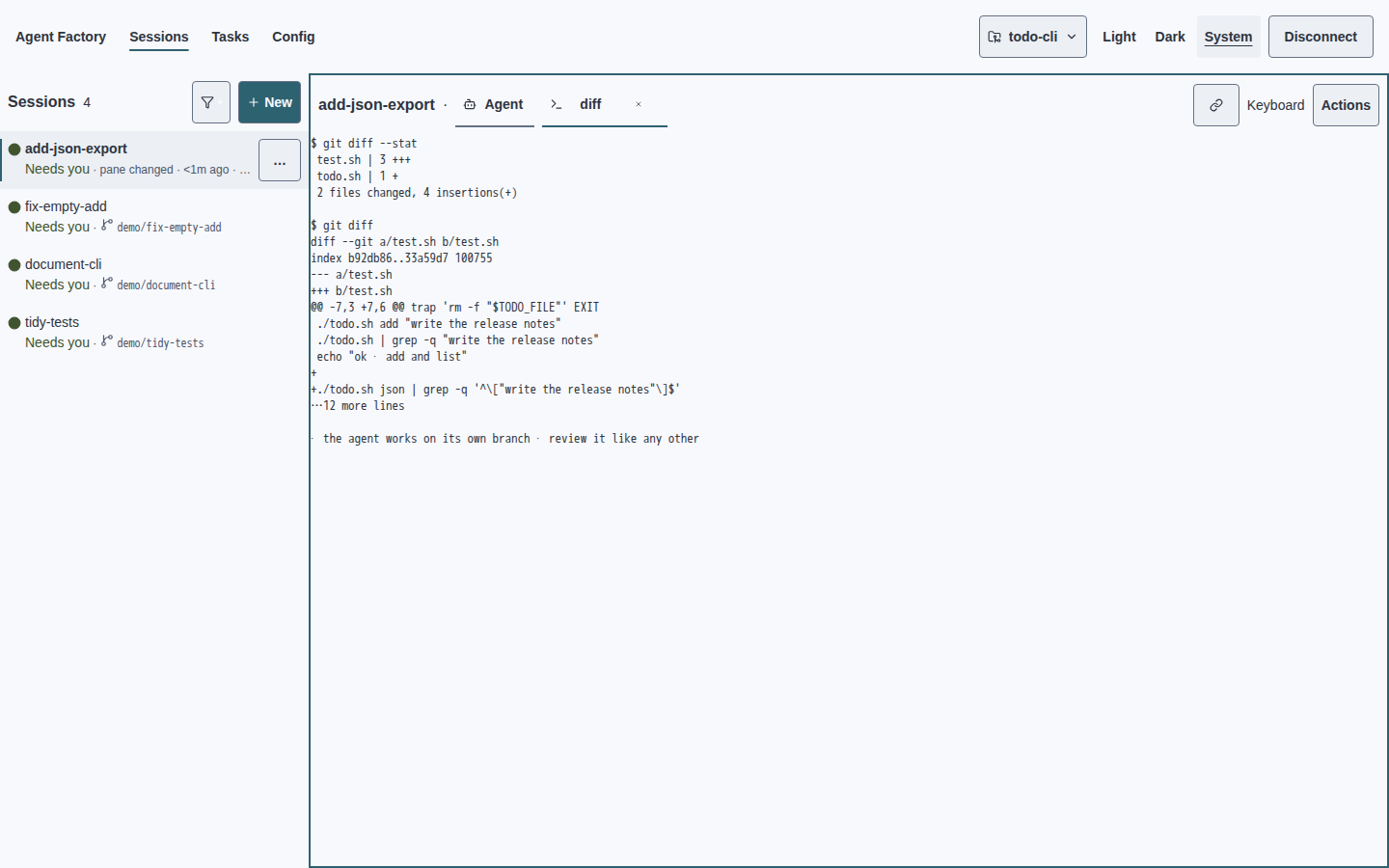
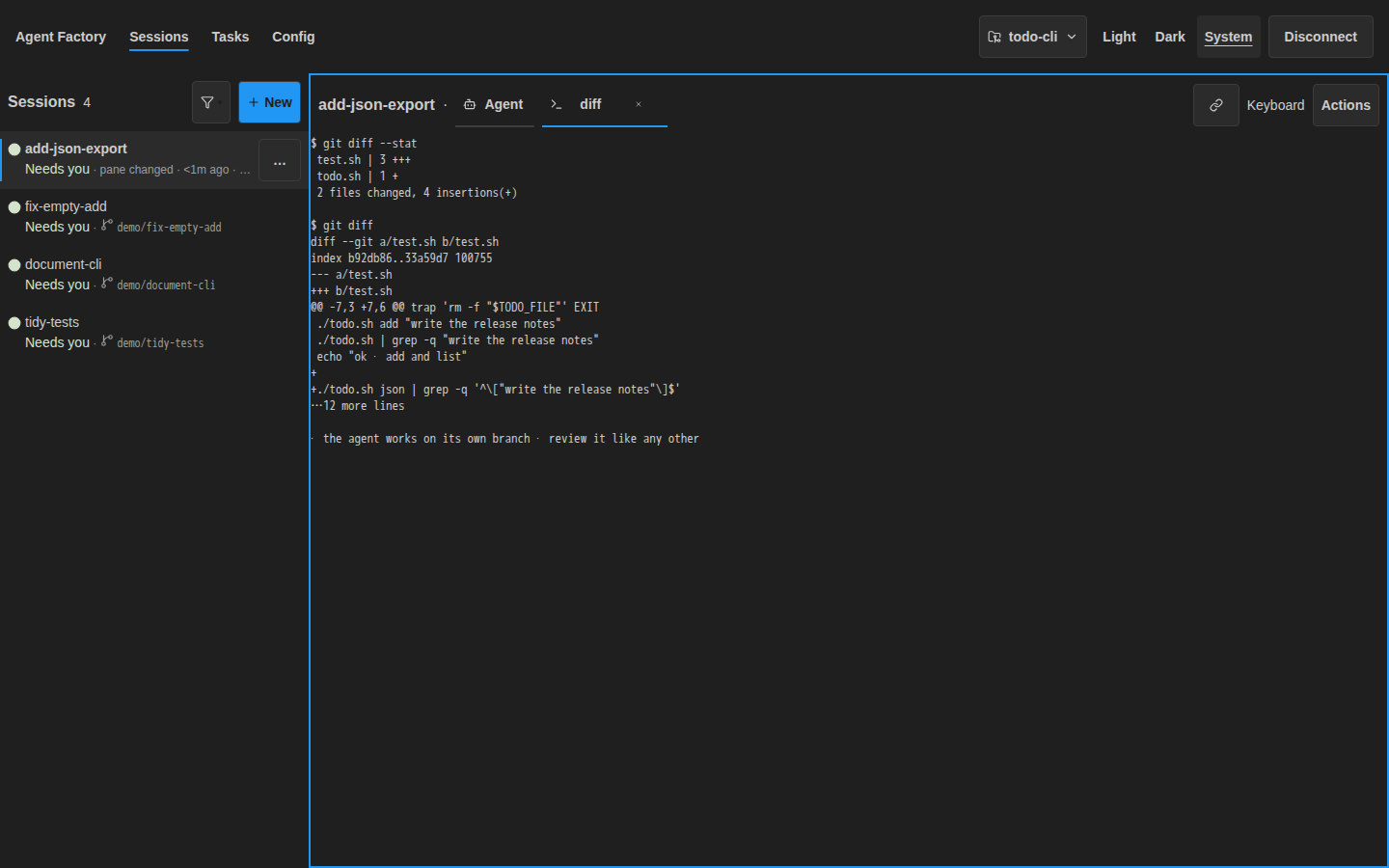
One task becomes one branch/worktree, supervised from the web client, TUI, CLI, and daemon API. | Git review, cron/watch automation, remote hooks, usage-limit recovery, and recoverable lifecycle are the core product. Supports Claude Code, Codex, Aider, Gemini, Amp, opencode, and Devin through named agent choices. |
| Agent terminal multiplexers | Herdr, Agent Deck, Claude Squad | Keep many live terminal agents visible, switchable, and persistent. | Agent Factory is more opinionated about repo-scoped sessions, worktree ownership, task scheduling, and archive/restore semantics. |
| Desktop worktree apps | Conductor, Superset, Nimbalyst, Crystal | Visual workspace management, built-in diff review, and local parallel branches. | Agent Factory offers web and terminal clients and hands review back to normal git/PR tools. |
| Kanban/review boards | Vibe Kanban | Plan, dispatch, review, and track many agent tasks as team work items. | Agent Factory is lighter and repo-local, with cron/watch automation instead of a shared planning board. |
| Built-in agent dashboards | Claude Code Agent View, Codex in ChatGPT | Native multi-session surfaces for one agent ecosystem. | Agent Factory is agent-agnostic across Claude Code, Codex, Aider, Gemini, Amp, opencode, and Devin, with one lifecycle around all of them. |
| Cloud coding agents | Codex cloud, Copilot cloud agent, Cursor Cloud Agents, Jules, Devin | Delegate work to hosted environments and return for review or PRs. | Agent Factory keeps work local by default and gives you direct terminal/process control. |
| Single-agent CLIs | Claude Code, Codex CLI, opencode, Aider, Gemini CLI, Amp, Crush | One focused coding loop in a terminal or editor. | Agent Factory runs and supervises those tools as fleet members rather than replacing their agent loop. |
| Manual stack | tmux/Zellij, git worktree, cron, shell scripts | Maximum control with the fewest product assumptions. | Flexible but self-managed: naming, scheduling, cleanup, restore, and safety checks are yours. |
Tool by tool
| Tool | Category | Primary interface | Isolation and review model | Best fit | Agent Factory contrast |
|---|---|---|---|---|---|
| Agent Factory | Terminal orchestration | Web client, TUI, JSON CLI, local HTTP API | One normal session creates one branch and git worktree; archive/restore/kill are explicit. | Local multi-agent repo work where reviewable branches and automation matter. | Baseline. |
| Herdr | Agent terminal multiplexer | Terminal panes, mouse/keyboard UI, CLI/socket API | Persistent real PTYs and agent state; worktree workflow can sit around the terminal runtime. | People who want a true terminal multiplexer redesigned around agents. | Herdr is stronger as a general live terminal runtime; Agent Factory is stronger as a repo/worktree/task lifecycle manager. |
| Agent Deck | Agent terminal manager | Terminal dashboard | Groups, search, forking, worktrees, cost tracking, and phone-controlled conductor workflows. | Managing many terminal-agent sessions across projects. | Agent Deck is broader fleet management; Agent Factory is narrower around repo-scoped daemon state, tasks, and branch lifecycle. |
| Claude Squad | Terminal worktree manager | TUI | Multiple AI terminal agents in isolated git workspaces with review/check-out flows. | Lightweight terminal management for local agents. | Agent Factory is a fork that adds per-repo scoping, daemon-owned state, tasks, remote hooks, JSON CLI, HTTP API, archive/restore, and generated docs. |
| Conductor | Desktop worktree app | macOS desktop app | Each task gets a workspace, branch, files, terminal, diff, and review path. | Visual local workflow for parallel Claude Code, Codex, Cursor, and opencode work. | Conductor has a stronger visual review surface; Agent Factory stays terminal-native and scriptable. |
| Superset | Desktop/workspace app | Desktop app | Runs many coding agents in parallel and emphasizes ready-for-review diffs. | Users who want visual parallel execution and review queues on one machine. | Superset is more GUI/review-board oriented; Agent Factory is CLI/API/daemon oriented. |
| Nimbalyst | Visual agent workspace | Desktop/web-style visual workspace | Kanban, worktrees, inline AI diffs, and Claude Code/Codex workflows. | Teams or individuals wanting an integrated visual workspace around agent output. | Nimbalyst is a broader visual environment; Agent Factory is a small terminal control plane. |
| Crystal | Desktop worktree app | Electron desktop app | Parallel Claude Code/Codex sessions against git worktrees. | People who liked the original Crystal multi-session local workflow. | Crystal is now positioned as Nimbalyst's predecessor; Agent Factory keeps the terminal-first version of this pattern. |
| Vibe Kanban | Kanban/review board | Web app/project board | Issues become workspaces where supported agents execute; status and PRs feed back into the board. | Planning and reviewing many agent tasks, especially in a team setting. | Vibe Kanban owns planning/review; Agent Factory owns local session/process/worktree lifecycle. |
| Claude Code Agent View | Built-in agent dashboard | Claude Code native view | Background sessions use isolated .claude/worktrees/ before editing files. |
Claude Code users who want native multi-session status and background work. | Agent View is excellent inside Claude's ecosystem; Agent Factory wraps several agent CLIs and exposes daemon/CLI/API automation. |
| Claude Code worktrees | Manual/native agent workflow | Claude Code CLI/docs workflow | You create or rely on worktrees for parallel Claude file isolation. | Claude-only users comfortable managing terminals and git workflow directly. | Agent Factory automates session creation, status, restore, archive, tasks, and cross-agent support. |
| Codex in ChatGPT / Codex cloud | Hosted coding agent | ChatGPT/Codex web, cloud environments | Built-in worktrees/cloud environments; background parallel tasks; review diff or open PR. | Delegating longer work to hosted environments without tying up a local machine. | Codex cloud is stronger for hosted background delegation; Agent Factory is local, terminal-first, and agent-agnostic. |
| Codex CLI | Single-agent CLI | Local terminal TUI/CLI | Works against the selected local repository; can be scripted with codex exec. |
A focused local OpenAI coding loop. | Agent Factory can launch Codex sessions in isolated worktrees and supervise many at once. |
| GitHub Copilot cloud agent | Hosted code agent | GitHub issues, agents tab, dashboard, Copilot Chat | Runs autonomously in a GitHub Actions-powered environment, makes branch changes, and can open PRs. | GitHub-centered teams who want issue-to-PR delegation. | Copilot cloud agent is hosted and GitHub-native; Agent Factory is local/process-native and works across agent CLIs. |
| Cursor Cloud Agents | Hosted/editor-adjacent agent | Cursor cloud/editor workflow | Runs Cursor Agent in cloud environments for continuous assistance. | Cursor users who want background cloud tasks tied to their editor workflow. | Cursor owns the editor/cloud experience; Agent Factory owns a terminal daemon and local worktrees. |
| Google Jules | Hosted coding agent | Web, GitHub, CLI/API | Clones a repo into a Cloud VM, develops a plan, and can work asynchronously. | GitHub-connected cloud coding tasks with Google/Gemini infrastructure. | Jules is hosted and task-oriented; Agent Factory keeps the working processes on your local or hook-defined backend. |
| Devin | Autonomous cloud engineer | Devin web app, integrations, API | Cloud-based engineer that can write, run, test code, create PRs, and participate in review workflows. | Larger delegated engineering tasks and review workflows managed in Devin. | Devin is an autonomous hosted teammate; Agent Factory is a local supervisor for agent CLIs you already run. |
| opencode | Single-agent CLI/editor/desktop agent | Terminal, IDE, desktop | Open source coding agent with multi-session support and session sharing. | Users who want an open source agent loop across terminal/editor/desktop. | opencode is the agent; Agent Factory runs it as one session type and adds worktree isolation, session lifecycle, and task orchestration around many of them. |
| Aider | Single-agent CLI pair programmer | Terminal REPL | Edits local git repos directly and supports many model providers. | Model-flexible terminal pair programming, especially in existing git repos. | Aider is one excellent worker; Agent Factory gives many workers isolated worktrees and shared lifecycle. |
| Gemini CLI | Single-agent CLI | Terminal | Open source Gemini-powered ReAct loop over local tools and MCP servers. | Terminal users in the Google/Gemini ecosystem. | Agent Factory can run Gemini CLI as one session type but adds worktree/session/task orchestration around it. |
| Amp | Single-agent terminal/editor agent | Terminal and editor | Frontier coding agent with threads and multi-model behavior. | People who want a polished, fast-moving agent CLI/editor loop. | Amp is the coding agent; Agent Factory is the terminal control plane around many agent processes. |
| Crush | Single-agent terminal agent | Terminal TUI | Open source Charm terminal coding agent wired into local tools and LLMs. | Users who like a Charm-style terminal UX for one agent session. | Crush improves one agent loop; Agent Factory organizes multiple loops and branches. |
| tmux/Zellij + manual worktrees | Manual terminal stack | Terminal multiplexer and shell | You create worktrees, panes, prompts, logs, cleanup, and review paths yourself. | Teams with strong shell discipline and custom scripts. | Agent Factory packages the common policy: repo-scoped sessions, daemon state, scheduling, JSON output, and safe cleanup. |
| Plain git worktrees + scripts | Manual git workflow | Shell scripts, cron, CI | Worktrees provide isolation; scripts provide launch/schedule/cleanup if you build them. | Maximum control and minimal dependency surface. | Agent Factory is the prebuilt version of the operational scaffolding. |
Capability matrix
| Capability | Agent Factory | Herdr | Desktop worktree apps | Kanban/review boards | Built-in dashboards | Cloud agents | Manual stack |
|---|---|---|---|---|---|---|---|
| Local terminal-first workflow | Yes | Yes | Partial | No | Depends | No | Yes |
| Worktree isolation by default | Yes | Varies | Usually | Usually workspace-backed | Yes for some surfaces | Hosted branch/env | Manual |
| Many agents at once | Yes | Yes | Yes | Yes | Ecosystem-specific | Yes | Manual |
| Persistent session supervision | Daemon-owned | Runtime/server-owned | App-owned | App-owned | Product-owned | Cloud-owned | tmux/scripts |
| Built-in scheduler/watch automation | Yes | API/scriptable | Varies | Board-triggered | Varies | Integrations | cron/scripts |
| JSON CLI/API surface | CLI + local HTTP | CLI/socket | Varies | Varies | Varies | Product API | Whatever you build |
| Built-in diff/review UI | No, use git/PR tools | No, terminal-first | Usually | Usually | Usually | Usually | No |
| Remote/cloud execution | Remote hooks | SSH/remote attach | Varies | Often hosted | Product-specific | Native | SSH/manual |
| Archive/restore session lifecycle | Yes | Persistence-focused | Varies | Workspace lifecycle | Product-specific | Product-specific | Manual |
When to choose Agent Factory
Choose Agent Factory when your desired unit of work is:
It is a good fit when you want:
- web and terminal clients around live agent processes;
- every normal session isolated by git worktree by default;
- a daemon-owned state model shared by the web client, TUI, CLI, and API;
- built-in cron/watch automations;
- explicit archive, restore, kill, and usage-limit recovery behavior;
- local and remote sessions under one repo-scoped view.
When to choose something else
Choose Herdr or Agent Deck when the live terminal workspace itself is the product: persistent panes, fast switching, agent state, direct attach, and a general control surface for terminal processes.
Choose Conductor, Superset, Nimbalyst, or Crystal-style tools when you want a visual app around parallel workspaces, inline diffs, and review queues.
Choose Vibe Kanban when the primary pain is planning, assigning, reviewing, and tracking agent work as team-visible issues.
Choose Claude Code Agent View or Codex in ChatGPT when you want the native dashboard inside one agent ecosystem.
Choose Codex cloud, GitHub Copilot cloud agent, Cursor Cloud Agents, Jules, or Devin when you want hosted background execution and a review/PR handoff instead of local terminal control.
Choose a single-agent CLI such as Claude Code, Codex CLI, opencode, Aider, Gemini CLI, Amp, or Crush when you only need one focused agent loop. Most of these are agents Agent Factory can run for you — reach for the CLI on its own when one loop is all you want, and for Agent Factory once you want several of them isolated, supervised, and reviewable.
Choose tmux/Zellij + manual worktrees when you want the fewest moving parts and are comfortable owning all lifecycle policy yourself.
Source notes
- Agent Factory behavior is documented in Worktree-isolated agents, The daemon, Tasks & automation, Remote hooks, the CLI guide, and the generated CLI reference.
- Terminal/orchestration tools: Herdr, Herdr compare, Agent Deck, Claude Squad, and claude-worktree.
- Desktop/workspace tools: Conductor docs, Superset, Nimbalyst, Nimbalyst on Crystal, and Crystal.
- Planning/review tools: Vibe Kanban, Vibe Kanban docs, and supported agents.
- Built-in or hosted agent surfaces: Claude Code Agent View, Claude Code worktrees, Codex in ChatGPT, Codex cloud, GitHub Copilot cloud agent, Cursor Cloud Agents, Google Jules, and Devin docs.
- Single-agent CLIs: Codex CLI, opencode, Aider, Gemini CLI, Amp, and Crush.
- tmux describes itself as a terminal multiplexer with detachable sessions, and git's isolation primitive is git-worktree.